
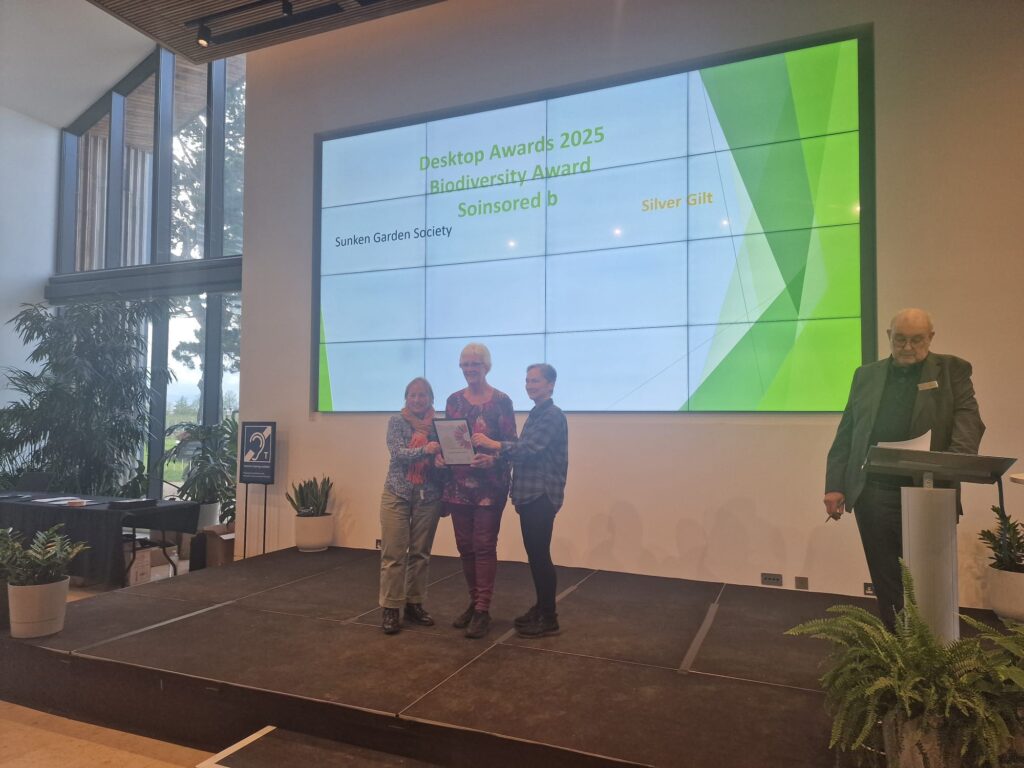
We were thrilled to return to RHS Wisley in October 2025 to receive a Level 5 It’s My Neighbourhood Award and an RHS Silver Gilt Biodiversity Award for the Sunken Garden. We have been saving the news as we wanted to share our submission, which takes you through the year in the Garden. It was written in July 2025, so refers to what took place last year.


The Sunken Garden Society, a voluntary community group, was established to reinvigorate a hidden gem at the heart of Thanet, bringing it back to its former glory for the local communities to use and enjoy.
The Sunken Garden is situated on the clifftop beside Royal Esplanade, Margate Kent CT9 5EJ
Biodiversity (bigh-oh-digh-VUR-suh-tee) Oxford English Dictionary
Diversity of plant and animal life, esp. as represented by the number of extant species.
With a coastal location, the chalky alkaline soil of the Sunken Garden has both advantages and disadvantages for plants. While good drainage is an advantage, in long hot Thanet breezy summers, the soil dries out very quickly. Plants here in the Garden have been selected to thrive in this unique coastal location. They must withstand regular north-easterly, salt-laden winds and the maritime climate.
Planting in the Garden is mindful of this with the creation of habitat for fauna, alongside growing flowers and shrubs for pollinators.
Regular Community Gardening Days are held throughout the year, bringing the community together to plant, sow and maintain the Garden. These often incorporate monitoring sessions for birds and insects.
The Sunken Garden Year follows the seasonal changes of the calendar, with Community Gardening Days taking place on the second Tuesday and last Saturday of each month.
The year begins as winter leaves the Garden, with the RSPB Big Garden Birdwatch, where there are experts on hand with binoculars and knowledge, to help identify the birds and share tips on how to attract birds into gardens at home. This year we were joined by Greg from Bird Wise East Kent and members of Thanet RSPB, plus Little Egret Pottery with their beautiful ceramic bird feeders. Between us we spotted more than seagulls (although we discovered that is a mis-nomer from one of the Bird Wise leaflets ‘There’s no such thing as a seagull!’) and saw blackbirds, woodpigeons, hedge and garden sparrows and the chirpy robin, along with flocks heading further afield flying overhead.
RSPB Big Garden Birdwatch is the world’s largest garden wildlife survey. Every year hundreds of thousands of nature lovers like you take part, helping to build a picture of how garden birds are faring.
As the ground warms and we move towards spring, over the next couple of months we hold a seed swap – sharing the seeds of pollinators that have been harvested in the Garden and stored safely. We also join in with the RHS Grow With It initiative, which brings people together to discover the plants that encourage biodiversity, attracting pollinating insects including bees, hoverflies and butterflies and discovering the benefits of green space and connecting with nature. We see white tail bumblebees on the lavender and rosemary, red tail bumblebees on the clover in the lawn. Solitary bees including black mining bees, are seen alongside hoverflies, shield bugs and fire bugs. Pollinators in the Garden include lavender, nepeta, perovskia, echinops, sea holly and rosemary.
Gaps in the limestone walls in the Garden make a perfect spot for nesting bumblebees in the spring.
During our 2024 Eco Fair, held in the autumn, artist Louis Michel, created a bee sculpture on site, using steamed UK harvested willow. Louis is internationally known for his environmental messaging and discussions surrounding the plight of pollinating bees. This led to indigenous, pollinating climbing plants being encouraged to spindle their way around the entirety of the sculpture. Within 3 to 4 years the blooms of these plants will completely cover the willow, encouraging more local pollinators to visit. The signage beside the sculpture raises awareness in visitors to the Garden.
Hedge maintenance and pruning of plants is restricted during the nesting seasons, to enable birds and wildlife to nurture their young undisturbed by man. With blackbirds, sparrows, robins and woodpigeons incubating their eggs in the Garden, the birdlife continues to thrive and bring its distinctive sounds.
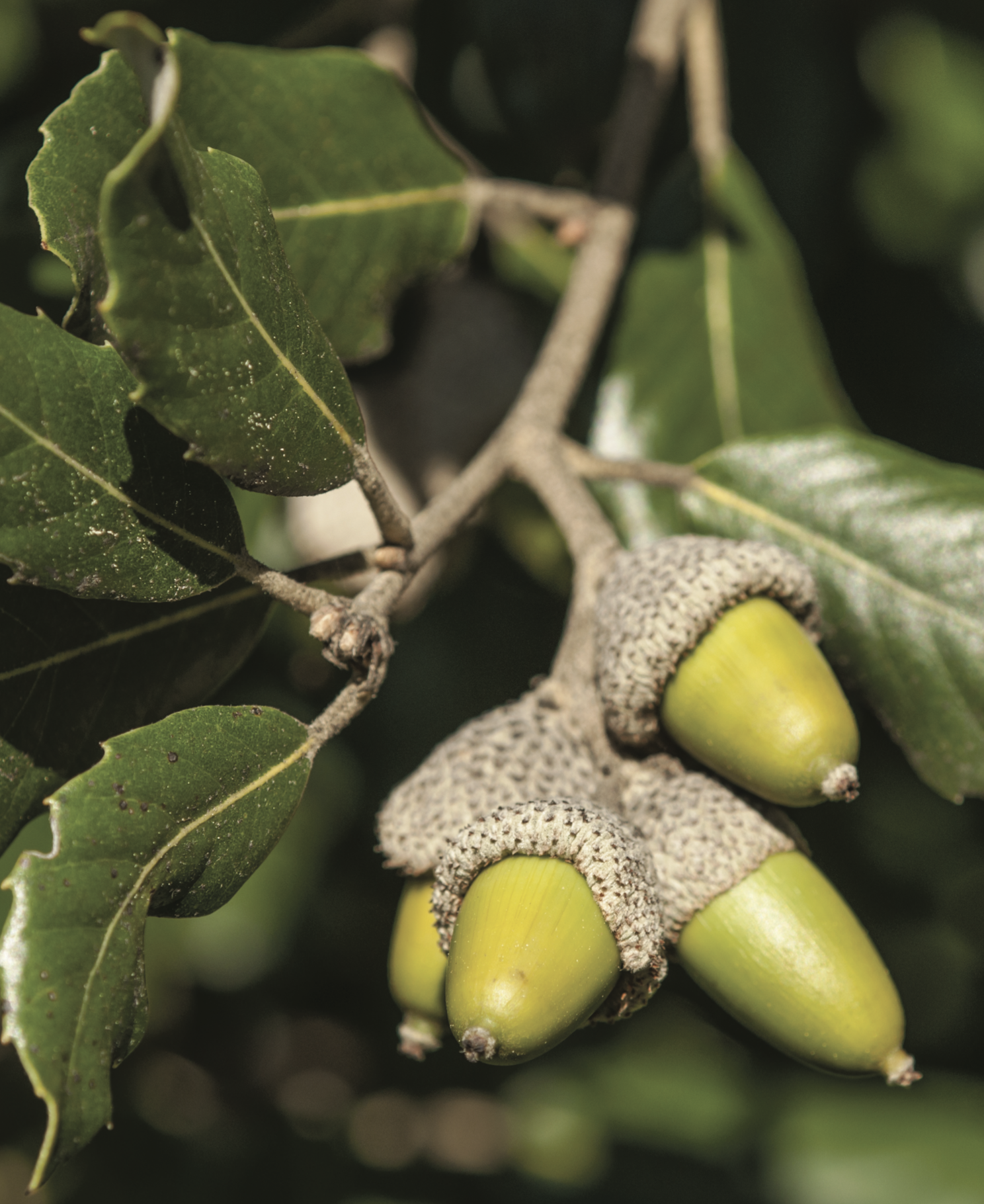
We welcome young people into the Garden and they are an important part of the community, the next generation of custodians. We support teenagers undertaking their Duke of Edinburgh’s Awards and local Scout groups drop in to help with moving leaves, fallen from the evergreen oaks, to the hedgelines,where they can break down slowly, feeding millions of microorganisms and making excellent compost and mulch, meanwhile proving valuable habitat for the many ground-dwelling invertebrates.
“They were super involved and engaged in learning about insects and different flower types and took away some knowledge about weeds. We were super impressed with the knowledge and enthusiasm that Peter gave the scouts.“ Foggy, Scout Leader
Summer brings the bees and butterflies into the Garden, with monitoring taking place during the Big Butterfly Count, initiated by Butterfly Conservation, and with participants of all ages we counted 10 species with over 100 butterflies in the Sunken Garden, including large white, small white, gatekeeper, green veined white, meadow brown, red admiral, holly blue, common blue and Jersey tiger. Described as taking the pulse of nature, counting butterflies helps to assess how much help nature needs. The data from this, and other counts across the UK, also helps identify important trends in species that assist in planning how to protect butterflies from extinction, as well as understanding the effect of climate change on wildlife.
Working with the Bumblebee Conservation Trust the range and abundance of pollinator-friendly plants has been increased and the Garden contains a variety of plants chosen to suit the needs of a diversity of bees and to extend the forage season for bumblebees and other pollinators throughout the year. Tree echiums, planted in 2018 as tiny plants are now towers of foraging bees through the summer months.
As summer comes to an end, we are in full preparation for the Sunken Garden Eco Fair, 2025 brings its third iteration. The Garden is filled with organisations and businesses who hold nature, wildlife, ecology, conservation, tree care, sustainability and gardening in dry conditions at their hearts. Speakers share their knowledge on topics from hedgehogs to peat and workshops offer foraging walks, trails for children and growing edible plants. With over 40 information points and stalls the day passes too quickly in conversation, discussion and knowledge sharing.
As we move into winter the community joins in the planting of 1000s of spring bulbs, including crocus, snowdrops and muscari, to bring a bright and colourful display whilst increasing the foraging for all the early emerging pollinators from February onwards. There’s no need for know-how, just a community spirit and warm clothing. We also make festive wreaths with long cuttings from trees in the garden, decorated with seed heads and evergreens foraged from the plants.
Dead trees are planted over the winter, as standing dead wood holds additional benefits for garden ecology and biodiversity. Our log pile is already on the PTES map and makes great habitat for stag beetles and other insects. Leaving some areas of the garden ‘untidy’ means hibernating bumblebees can find shelter and protection during the winter.
National Tree Week is celebrated with a Tree Walk around the Garden, sharing insights and knowledge about the trees, animal life and biodiversity of the area.